%20(500%20x%20180%20px)%20(1).png?width=115&name=Untitled%20(500%20x%20200%20px)%20(500%20x%20180%20px)%20(1).png)
%20(7).png?width=115&name=Untitled%20(500%20x%20200%20px)%20(7).png)

G-Cloud 15 suppliers typically fund growth through receivables-based facilities, asset-based lending, term debt and structured growth capital. Which one fits depends on where the cost falls in the contract lifecycle - bidding, mobilisation, delivery or expansion - because public sector contracts commit a supplier to spending well before the first payment arrives.
There is a particular quiet that follows a framework award. The bid team has done its work, the listing is live, and everyone waits to see what comes through. Somewhere in that gap, a finance conversation should be happening, and in our experience it usually starts later than it should.
We work with UK cloud, managed service and cybersecurity businesses on how they fund growth, and public sector contracts have a distinctive shape. The revenue is good quality and often long-dated. The cost of earning it lands first. This article sets out how G-Cloud 15 suppliers fund that gap, which options suit which situation, and what a capital partner will want to understand about your business before any of it is on the table.
What is G-Cloud 15, and what has changed?
G-Cloud 15 is the Crown Commercial Service framework through which UK public sector organisations buy cloud hosting, cloud software and cloud support. It was awarded on 6 August 2026 and runs as a four-year open framework, with an estimated value of £14bn excluding VAT. It is the first G-Cloud iteration to operate under the Procurement Act 2023.
Three changes matter if you are the person responsible for cash.
The first is contract length. Maximum call-off terms are materially longer than under G-Cloud 14, reaching up to eight years in the hosting lots. Longer contracts mean a bigger commitment made at the point of award, and a longer horizon over which the cost of servicing it is recovered.
The second is that the economic and financial standing requirements are now more differentiated by lot. The hosting lots carry heavier certification and insurance obligations than the rest of the framework. Those obligations have a price, and it is paid whether or not a call-off follows.
The third is that Cyber Essentials certification now applies across the supplier base rather than to particular lots. For most established suppliers this is already in hand. For those scaling into new lots, it is one more fixed cost sitting ahead of the revenue.
A place on the framework is not the same as revenue
This is the part worth being blunt about. A G-Cloud listing is permission to compete, not a guarantee of anything. Analysis of G-Cloud 13 published by Stotles found that only 23% of listed suppliers won a call-off contract.
The money is certainly real - roughly £3.1bn of cloud spending flowed through G-Cloud in 2023-24 - but it is concentrated among suppliers who can respond quickly and mobilise credibly when a call-off appears.
That capability is partly commercial and partly operational. It is also, more often than people expect, a capital question. The supplier who can commit to hiring a delivery team in week two is in a different competitive position from the supplier who has to wait for the first payment to clear before recruiting. Both may be equally capable. Only one of them looks like a safe pair of hands to a buyer with a deadline.
What growth capital options exist for companies selling to government through G-Cloud?
There are five structures we see used most often by public sector suppliers, and they solve different problems. Most businesses end up with a combination rather than a single facility, because the costs arrive at different points and in different shapes.
|
Option |
What it funds |
When it tends to fit |
|
Receivables-based facilities |
Converts delivered, invoiced work into cash sooner |
Delivery is complete but payment terms and administrative cycles stretch the wait |
|
Asset-based lending |
Headroom drawn against receivables and other qualifying assets |
A growing debtor book, where funding needs to scale with delivery rather than be renegotiated each time |
|
Term debt |
Mobilisation costs - hiring, equipment, onboarding, accreditation |
A defined upfront cost recovered over a contract measured in years |
|
Revolving working capital |
Day-to-day operating headroom |
Uneven call-off timing, where the peaks and troughs matter more than the annual total |
|
Growth and acquisition capital |
Delivery capacity, new lot coverage, or buying a business that already holds both |
Expansion that is strategic rather than contract-specific, where equity dilution is unattractive |
The instinct in a lot of businesses is to reach for whichever facility the incumbent bank offers, or to self-fund from reserves and absorb the strain. Both can be the right answer. Both are worth testing against the alternative, because the cost of a facility is only half the comparison - the other half is what the business could not do while its cash was committed elsewhere.
A point on what we do: Fuse Capital is not a lender and not a broker. We are a strategic capital partner. That means we work out what structure the business actually needs, then run a proper process across the capital market to find it. The distinction matters, because the answer to "what funding should we take?" should not be decided by whoever happens to be selling.
|
The B2G Funding Playbook Our playbook works through each of these options in more detail, with the contract timing attached: what suits mobilisation, what suits an uneven delivery schedule, and what to have ready before you approach the market. |
Matching funding to the contract lifecycle
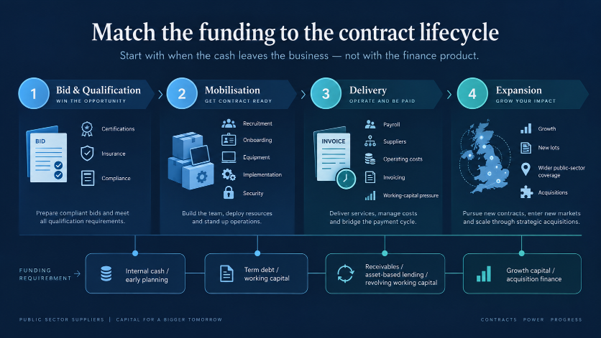
The most useful way to approach this is not to ask which facility is best, but to ask when the money leaves the business. A public sector contract has four distinct phases, and each raises a different funding question.
|
Phase |
Where the cost falls |
The funding question |
|
Bid and qualification |
Bid resource, certifications, insurance, financial standing evidence |
Can we carry the cost of qualifying for lots we may not win in the first year? |
|
Mobilisation |
Hiring, onboarding, equipment, implementation, security clearance |
Can we commit to delivery capacity before the first payment lands? |
|
Delivery |
Payroll and supplier costs running ahead of invoicing and settlement |
Can we absorb the working capital cycle across several concurrent call-offs? |
|
Expansion |
New lots, wider public sector coverage, acquisitions |
Can we scale without diluting ownership or over-committing the balance sheet? |
Most funding conversations that go badly are the ones that start in the delivery phase, when the pressure is already visible. The ones that go well tend to start somewhere around bid and qualification, when there is still time to choose.
Moving from G-Cloud 14 to G-Cloud 15 without a cash-flow gap
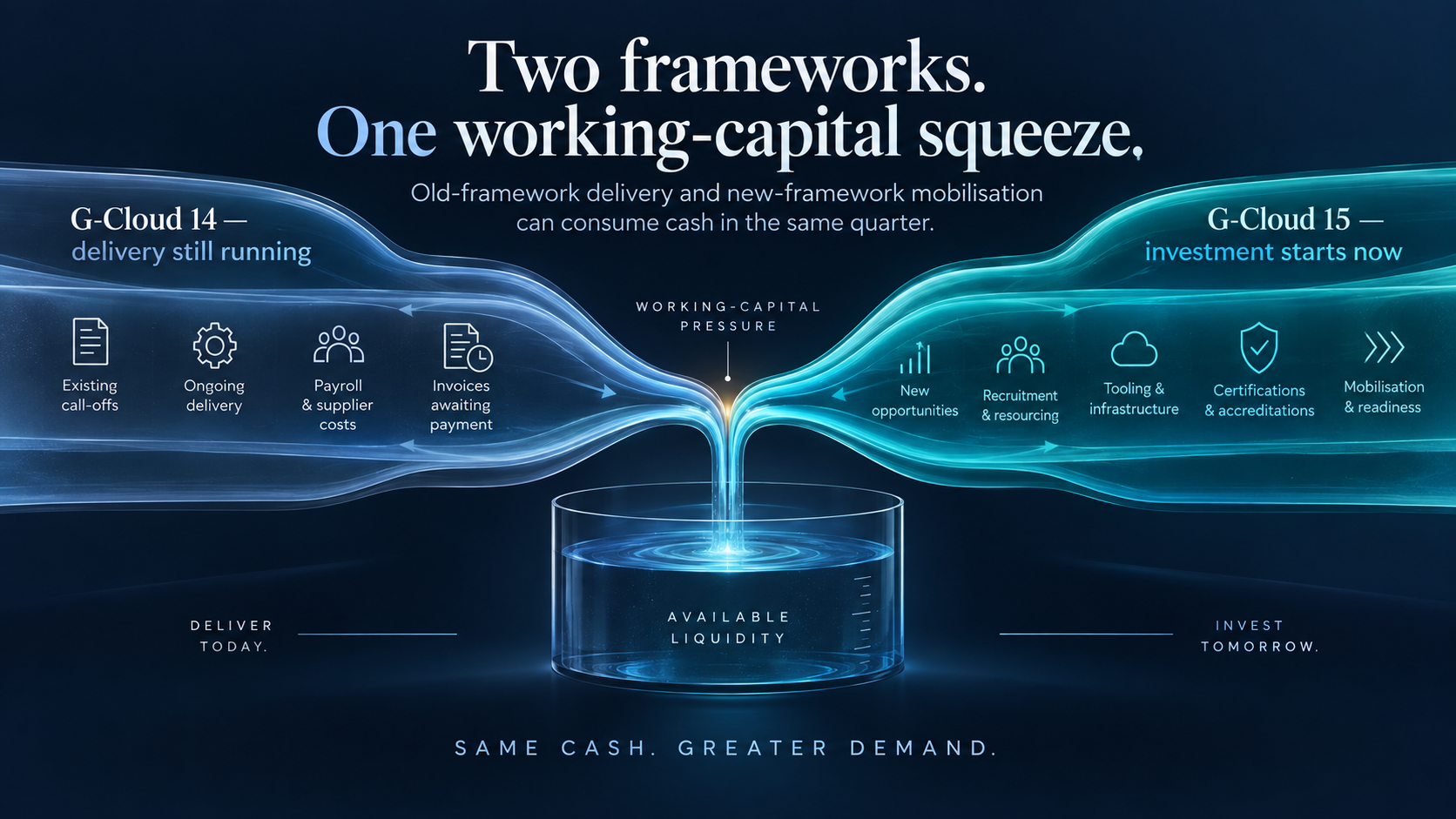
G-Cloud 14 remains available to buyers until 28 October 2026, so for a period suppliers are working across both frameworks at once. Work does not transfer between them: anything agreed under G-Cloud 14 stays on G-Cloud 14 terms, and any new call-off under the old framework has to be signed before it expires.
For finance, the overlap creates a squeeze that is easy to miss. On one side, G-Cloud 14 call-offs are still being delivered and invoiced. On the other, G-Cloud 15 opportunities need people, tooling and accreditations in place before the first payment arrives. Both consume cash in the same quarter.
Three questions are worth answering now rather than in December:
-
What is the largest mobilisation we could commit to in the next two quarters without new funding, and what would it leave us unable to do?
-
Where do our existing facilities sit against their limits at the point where both frameworks are running?
-
If a significant call-off landed in the next 90 days, how quickly could we resource it - and would that answer be good enough to win the work?
What capital partners look at in a public sector supplier
Public sector revenue is generally viewed favourably. The counterparty is strong and the contracts are long. But the analysis goes further than that, and knowing where it lands makes the process considerably faster.
-
Quality of receivables. Who the debtor actually is, how settlement has behaved historically, and whether invoicing is clean and timely.
-
Concentration. How much of your revenue depends on a small number of buyers or a single framework, and what happens at renewal.
-
Contracted versus potential revenue. A framework place is potential. Signed call-offs are contracted. The two are weighed very differently, and presenting one as the other is the fastest way to lose credibility.
-
Obligations attached to the work. Insurance cover, certifications and service commitments are ongoing costs, and they are read as such.
-
Management information. Whether you can produce a reliable cash forecast and an accurate debtor ageing without a month of preparation.
-
Existing security and covenants. What is already pledged, and how much room the current arrangements leave.
-
None of this requires a finance function of any great size. It does require the information to be honest, current and quickly available.
FAQs
What is G-Cloud 15?
G-Cloud 15 is the Crown Commercial Service framework used by UK public sector buyers to purchase cloud hosting, cloud software and cloud support services. Awarded on 6 August 2026, it runs as a four-year open framework with an estimated value of £14bn excluding VAT, and it is the first G-Cloud iteration under the Procurement Act 2023.
When does G-Cloud 14 end, and what happens to existing contracts?
G-Cloud 14 remains available to buyers until 28 October 2026. Work does not move between frameworks: call-offs agreed under G-Cloud 14 continue on G-Cloud 14 terms for their duration, and any new call-off under the old framework must be signed before it expires.
How do G-Cloud suppliers fund contract mobilisation?
Mobilisation is usually funded with term debt or a working capital facility, because the cost is defined, lands upfront, and is recovered over a contract measured in years. Suppliers with a substantial debtor book often use asset-based lending instead, so that funding scales with delivery rather than needing renegotiation for each contract.
Can a business raise funding against a public sector contract?
Yes. Public sector receivables are generally regarded as good quality security because of the strength of the counterparty. What matters is the detail: whether the revenue is contracted or potential, how settlement has behaved historically, and how concentrated the business is on a small number of buyers.
Does a place on the G-Cloud framework guarantee revenue?
No. A framework place is permission to compete for call-offs, not a commitment by any buyer to purchase. Analysis of G-Cloud 13 published by Stotles found that only 23% of listed suppliers won a call-off contract, which is why funding decisions should be built on contracted revenue rather than framework presence.
Where to start
If you expect a funding gap in the next two quarters, the useful first step is not a facility. It is a clear view of when cash leaves the business against when it arrives, mapped across the contracts you hold and the ones you are realistically pursuing. That picture tends to make the decision for you, and it is the same picture any capital partner will ask for.
|
Start with the playbook The B2G Funding Playbook covers working capital planning, contract mobilisation and what capital readiness looks like for a public sector supplier. Start there - and if the numbers suggest a conversation is worthwhile, we are happy to have one. |