%20(500%20x%20180%20px)%20(1).png?width=115&name=Untitled%20(500%20x%20200%20px)%20(500%20x%20180%20px)%20(1).png)
%20(7).png?width=115&name=Untitled%20(500%20x%20200%20px)%20(7).png)
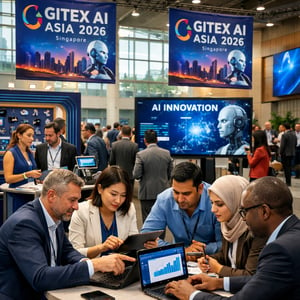
Explore five key takeaways from GITEX AI Asia 2026 in Singapore, including AI infrastructure, cybersecurity, startup investment, ASEAN digital regulation and Singapore’s role as a regional capital hub.
At GITEX AI Asia 2026, one thing became increasingly clear to us: businesses, governments and investors across Southeast Asia are moving beyond AI experimentation and product demos, and focusing more seriously on the infrastructure, regulation, capital and execution required to deploy and commercialise AI at scale.
Held in Singapore, the event brought together technology companies, startups, investors and public sector leaders from across the global digital economy. GITEX AI Asia 2026 convened more than 550 enterprises and startups, participants from more than 110 countries, and 250 global investors managing over US$350 billion in assets.
Fuse Capital’s Associate Directors, APAC, Dylan Chauhan and Clarise Kho, attended the event in Singapore, engaging with founders, investors, technology operators and wider ecosystem participants from across the region. Many of the themes discussed throughout closely reflected the conversations we are already having with growth-stage businesses navigating capital requirements, funding strategy, regional expansion plans and AI-driven transformation across Southeast Asia.
Based on the conversations, themes and market signals we observed throughout the event, here are five takeaways we believe will shape the next phase of AI adoption and digital growth in Southeast Asia.
1. AI Growth Is Becoming an Infrastructure Challenge
One of the strongest themes we observed throughout GITEX AI Asia was that AI adoption is no longer just a software issue. As companies move from pilots to production, the focus is shifting towards the foundational infrastructure required to support AI at scale.
Data centres, cloud infrastructure, power availability and edge computing are all becoming critical enablers of AI deployment. In Singapore and neighbouring markets, continued investment in digital infrastructure is expected to drive significant capital requirements as businesses and governments look to support higher volumes of data, low-latency applications and more complex AI workloads.
From a capital advisory perspective, this is becoming increasingly relevant for businesses scaling AI-enabled infrastructure, enterprise platforms and digital services. Many companies are now facing larger and more complex funding requirements as infrastructure investment becomes a critical part of long-term growth and deployment strategy.
This is particularly important for companies operating across sectors such as fintech, healthcare, logistics, cybersecurity and enterprise software, where AI models need to be embedded into real workflows and deployed securely across multiple markets.
In our view, the companies that scale AI successfully over the next few years will not necessarily be those with the most ambitious ideas, but those with the infrastructure required to deploy them effectively.
2. Cybersecurity and Digital Trust Are Now Central to AI Adoption
As AI adoption increases, so does the surface area for cyber risk. One of the clearest shifts we noticed was how closely cybersecurity, governance and digital trust are now tied to the broader AI growth story.
For Southeast Asia, this is especially important. The region is digitising rapidly, with governments, financial institutions and enterprises investing heavily in digital platforms, cross-border payments, e-commerce and AI-enabled services. However, accelerated digital adoption also brings greater regulatory scrutiny, higher compliance expectations and more pressure to protect user data.
Companies operating in regulated verticals are likely to face rising compliance costs as AI becomes more embedded in decision-making, customer engagement and operational processes. For these businesses, trust will become a commercial requirement rather than just a technical consideration.
We believe companies that treat security, auditability and governance as secondary considerations may struggle to scale AI effectively, particularly in sectors where customer confidence and regulatory alignment are essential.
3. Investors Are Backing Traction, Not Just Technology
Another clear takeaway for us was the growing investor focus on execution over narrative.
During North Star Asia’s Supernova Challenge, startups were assessed not only on technical strength, but also on their ability to demonstrate commercial value, product-market fit and scalability under pressure. This reflects a broader shift in the funding environment, where investors are increasingly looking for companies that can turn technology into durable business models.
For AI and deep-tech startups, technical differentiation remains important, but it is no longer sufficient on its own. In practical terms, this means fewer companies are being funded on narrative alone, with greater emphasis on distribution, revenue visibility and execution discipline alongside technical capability.
This is particularly relevant in a market where AI enthusiasm remains high, but capital is being deployed more selectively private capital and debt investment firms. Companies that can demonstrate traction, repeatable demand and a clear path to commercialisation are likely to stand out more strongly than those relying on innovation alone.
In our view, the funding environment is becoming increasingly selective. The companies most likely to attract long-term investor interest will be those that combine technical capability with disciplined execution and credible commercial traction.
4. ASEAN Digital Regulation Could Become a Structural Growth Enabler
We also saw strong emphasis placed on the importance of regulatory alignment across Southeast Asia.
ASEAN’s proposed Digital Economy Framework Agreement, known as DEFA, was discussed as a major potential catalyst for regional digital growth. The agreement is intended to support more harmonised rules across areas such as data, e-commerce, cybersecurity and digital payments, helping to reduce friction for businesses operating across multiple ASEAN markets.
This could be especially significant for fintechs and digital-first companies. Payment interoperability, for example, could allow companies licensed in one ASEAN market to expand regionally with less duplication of compliance infrastructure. That has the potential to lower expansion costs, speed up market entry and support more efficient cross-border growth.
For businesses building across Southeast Asia, regulatory fragmentation has often created complexity. If DEFA helps create a more consistent digital rulebook, it could enable companies to scale across the region with greater confidence.
More broadly, digital growth is not only about technology adoption. It also depends on the regulatory architecture that allows companies to expand confidently across borders.
5. Singapore Is Strengthening Its Position as a Regional AI and Capital Hub
From our perspective, GITEX AI Asia further reinforced Singapore’s position as a regional gateway for innovation, capital and enterprise demand.
The event brought together global technology providers, startups, investors and policymakers, positioning Singapore as a meeting point between international innovation and Southeast Asia’s digital growth markets. With Southeast Asia projected to become a US$2 trillion digital economy by 2030, Singapore’s role as a trusted hub for capital, regulation and regional expansion remains highly relevant.
For companies expanding across Asia, Singapore offers a strong base for regional growth. It provides access to investors, enterprise customers, talent, regulatory credibility and neighbouring high-growth markets. For investors, it remains a key platform for discovering companies building across ASEAN and the wider Asia-Pacific region.
The next phase of AI adoption will require more than technical innovation. It will require capital, infrastructure, partnerships, market access and regulatory confidence. Singapore is well positioned at the centre of that ecosystem.
Looking Ahead
Our key takeaway from GITEX AI Asia 2026 is that the next phase of AI growth in Southeast Asia will be defined less by experimentation and more by deployment, trust and scale.
We believe the companies best positioned to succeed will be those that can combine strong technology with the infrastructure, governance and commercial traction required to support real-world adoption. Investors are looking beyond ideas and towards execution, while governments and regulators are shaping the digital frameworks that will influence how quickly companies can expand across the region.
For founders and CFOs, this creates a more complex scaling environment where capital decisions, regulatory readiness and operational discipline are increasingly interconnected. Infrastructure, compliance, funding strategy and regional execution will all play a critical role in determining which businesses can convert innovation into sustainable growth.
Across many of the founder and CFO conversations we are having, there is growing recognition that scaling AI businesses now requires more than product innovation alone. Capital planning, infrastructure readiness, regulatory alignment and execution capability are becoming increasingly interconnected, particularly for companies expanding across multiple Southeast Asian markets.
For companies scaling across Southeast Asia, understanding the right funding options, private debt solutions and broader growth financing strategies will be an important part of turning that growth opportunity into a resilient capital strategy.
Speak to our team to explore the right capital strategy for your business