.png?width=115&name=Untitled%20design%20(86).png)
-1-3.webp?width=115&name=Fuse-Capital-Logo-1%20(1)-1-3.webp)

Private credit has never offered businesses more potential routes to capital. Yet finding the right funding can feel more complicated than ever.
The private credit market has grown into a major source of corporate finance, with global assets under management now exceeding US$2 trillion and projected to reach US$3.4 trillion by 2030, according to PwC. At the same time, the market is entering a more selective phase. Lenders are differentiating more carefully between opportunities, while private credit itself is becoming increasingly specialised across sectors, structures and risk profiles.
For businesses seeking funding, this creates a paradox. More capital should mean more choice. In practice, more choice can also mean more complexity.
The challenge is no longer simply finding a lender that can provide capital. It is understanding which capital is appropriate, which lenders are relevant and how to enter the market with a proposition that gives the business its best chance of securing the right outcome.
A bigger market does not mean a simpler one
Private credit is no longer synonymous with a single type of lender or financing structure.
Alongside established direct lenders, the market now includes specialist credit funds, asset-backed finance providers, growth and venture debt investors, structured capital providers and other forms of private financing. Different lenders operate with different mandates, transaction sizes, sectors, geographies, risk appetites and return requirements.
That expansion creates opportunities for borrowers. It also makes the funding market harder to navigate.
A business may technically have access to hundreds of potential lenders, but the number of lenders genuinely suited to its particular circumstances may be considerably smaller.
The distinction matters.
A lender providing private debt is not automatically the right lender for every private debt requirement. A business seeking acquisition finance may need a different type of capital from one refinancing existing facilities. An asset-rich company may have options that are less relevant to a business whose primary strength is recurring cash flow. A high-growth business may require a different structure from an established company seeking predictable working capital.
More lenders create more potential routes to capital. They do not necessarily create more relevant routes.
Capital is available, but it is becoming more selective
The current market is not defined by a simple shortage of capital. It is defined by greater differentiation.
Private credit continues to attract institutional capital, but deployment is becoming more disciplined as lenders navigate a more demanding credit environment. Recent market analysis points to increasing dispersion between stronger and weaker credits, with lenders paying greater attention to underwriting quality and the risks associated with different sectors and structures.
That distinction is important for borrowers.
When capital is abundant and broadly deployed, businesses can sometimes afford a less targeted approach to the market. When lenders become more selective, the cost of approaching the wrong ones increases.
A lender declining an opportunity does not necessarily mean the business is not financeable. It may simply mean the opportunity does not fit that lender's mandate, structure or current appetite.
The question therefore shifts from:
“Who can lend to us?”
to:
“Who is most likely to see this opportunity as a fit?”
That is a fundamentally different way of approaching a funding process.
The private credit market is becoming more specialised
The growing sophistication of private credit is creating another important shift.
Capital is increasingly organised around specific strategies and areas of expertise. Some lenders focus on established cash-generative businesses. Others specialise in asset-backed opportunities, growth businesses, particular sectors, transaction types or more complex financing structures.
This means that lender selection is becoming less about compiling the longest possible list and more about understanding the market well enough to identify genuine fit.
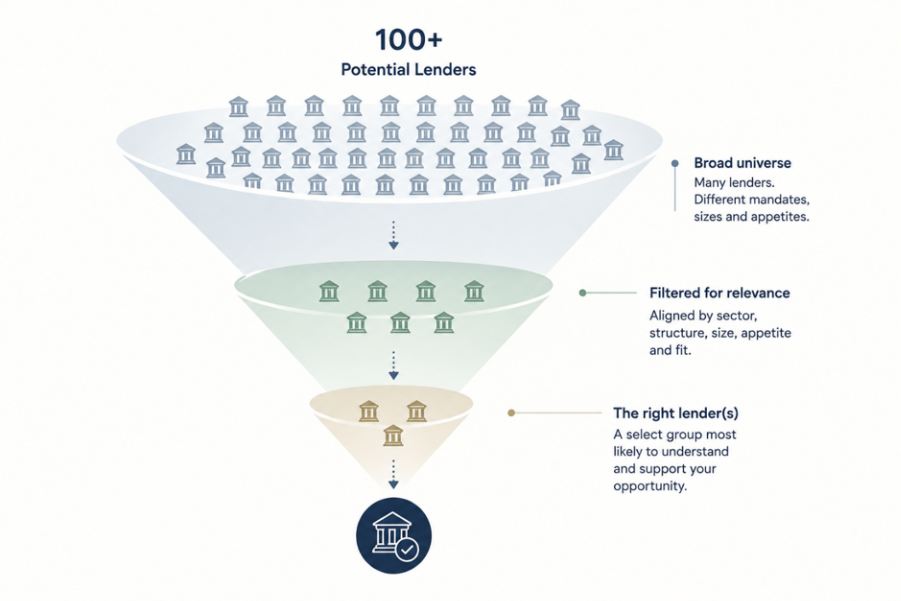
For borrowers, that can be difficult to do from the outside.
A business may know how much it wants to raise. It may know what the money will be used for. But understanding which lenders are most receptive to that particular combination of business profile, funding purpose, structure and risk requires a deeper view of the market.
That is where the idea of capital fit becomes important.
The right funding is not simply capital that is available. It is capital that fits the business.
Capital fit matters as much as capital access
Funding decisions are often reduced to a question of how much capital can be raised and at what price.
Those factors matter. But they are not the whole equation.
The structure of the financing can influence a company's flexibility, cash flow, risk and ability to pursue its next strategic move. Covenants, security, repayment schedules, pricing, duration and other terms can all shape the real cost and usefulness of capital.
A structure that looks attractive on one metric may be less suitable when viewed against the business's wider objectives
This is particularly relevant when businesses are considering different forms of private debt. Asset-backed financing, for example, may provide an alternative route for businesses with meaningful underlying assets, while growth or structured debt may be more appropriate in other circumstances. The expansion of private credit into specialist strategies is giving businesses more ways to finance themselves, but it also makes the question of fit more important.
The objective should not be to find capital at any cost.
It should be to find capital that supports what the business is trying to achieve.
The cost of entering the market the wrong way
There is another consideration that is easy to overlook: the funding process itself has a cost.
Approaching lenders that are unlikely to be interested can consume management time and create unnecessary friction. Repeatedly presenting the same proposition to lenders with different mandates can generate inconsistent feedback and make it harder to understand what is actually driving the market's response.
More importantly, a poorly targeted process can narrow the opportunity before the most relevant lenders have been engaged.
That is why market entry should be treated as part of the funding strategy, rather than as an administrative step once the funding requirement has been defined.
The objective is not to speak to as many lenders as possible.
It is to create the right conversations with the right lenders.
Refinancing is becoming a strategic decision
This matters not only for businesses seeking new growth capital, but also for companies approaching refinancing.
A significant volume of private credit originated during the lower-rate environment is moving towards maturity over the coming years. Refinancing activity is expected to become an increasingly important driver of private credit demand, making early planning more valuable.
For borrowers, that creates an opportunity.
Starting a refinancing process early can provide time to assess the market, consider alternative structures and understand the options available before the requirement becomes urgent.
A refinancing should not automatically mean replacing an existing facility with an equivalent one. It can be an opportunity to reconsider the capital structure, funding requirements and longer-term financial strategy of the business.
In a more selective market, that strategic window matters.
What should businesses do differently?
The answer is not necessarily to approach more lenders. It is to approach the market with greater clarity and purpose.
A strong funding process can be thought of in five stages:
Assess
Understand the business's financial position, funding requirement and strategic objectives before approaching the market.
Position
Develop a clear funding proposition that explains the requirement, the rationale behind it and the structure that best supports the business.
Match
Identify lenders whose mandate, appetite and approach are genuinely aligned with the opportunity.
Approach
Enter the market selectively, with a targeted proposition rather than a generic request for capital.
Negotiate
Evaluate competing options and negotiate terms that work for the business not only at completion, but throughout the life of the financing.
This approach turns lender selection from a numbers exercise into a strategic process.
Why the role of an advisor matters
As the private credit market becomes larger and more specialised, the value of an advisor extends beyond access to capital.
A strong lender network is useful. Knowing how to navigate that network is what creates value.
An advisor can help a business assess its funding position, identify relevant sources of capital, understand lender appetite, shape the funding proposition and manage the process through to completion.
The objective is not to introduce a business to every possible lender.
It is to identify the lenders most relevant to the requirement and create the conditions for a competitive, well-managed funding process.
That can be particularly valuable when the market is becoming more differentiated. A business may have a strong underlying proposition, but the outcome can still depend on whether it reaches the right lenders, at the right time, with the right structure.
More capital. More choice. More need for strategy.
Private credit is not becoming less important. It is becoming more sophisticated.
The market has more capital, more specialist lenders and more financing structures than it did a decade ago. For businesses, that creates genuine opportunity. But it also means that navigating the market requires more than identifying a list of potential funding providers.
More capital does not automatically mean more relevant capital.
The businesses best placed to benefit from the expanding private credit market will be those that understand their own position, recognise where they fit within the lender landscape and approach the market with a clear strategy.
The right funding outcome does not necessarily come from finding the most lenders.
It comes from finding the right capital, from the right lenders, for the right reasons.
How Fuse Capital can help
Fuse Capital helps established businesses navigate the private debt market and identify funding solutions aligned with their strategic objectives. From growth and working capital to acquisition finance, refinancing and structured debt, our advisory approach combines market knowledge, lender relationships and strategic positioning to help businesses approach the funding market with greater clarity and confidence.
Explore our private debt advisory solutions or speak to our team about your next funding requirement.