.png?width=115&name=Untitled%20design%20(86).png)
-1-3.webp?width=115&name=Fuse-Capital-Logo-1%20(1)-1-3.webp)

From growth and acquisitions to refinancing and working capital, the right debt structure can do more than provide capital. It can create flexibility, preserve strategic options and support the next stage of growth.
Capital should fit the business, not the other way around.
For years, businesses have often approached debt as a relatively straightforward transaction. Find a lender, negotiate the rate, secure the facility and deploy the capital. But as private credit has matured, the funding conversation has become considerably more sophisticated.
The market now encompasses far more than traditional direct lending. Businesses can increasingly consider tailored structures across growth finance, acquisition funding, refinancing, working capital and asset-backed finance, with terms designed around different cash-flow profiles, assets and strategic objectives.
That creates an important opportunity, but also a more important question.
What should your debt actually do for your business?
In 2026, the smartest funding decision is not necessarily the one with the lowest headline interest rate. It is the structure that provides the right combination of cost, flexibility, certainty and strategic headroom for the business's next stage.
From borrowing to strategic capital
Private credit has evolved from an alternative source of finance into an increasingly established part of the corporate funding landscape. Global private credit assets are expected to continue growing, while the market itself is broadening into areas such as asset-backed finance, specialty finance and other structured solutions.
For businesses, that evolution matters because funding requirements are rarely identical.
A company expanding into new markets may need capital that can accommodate investment before the resulting revenues fully materialise. An acquisitive business may value committed capital that can be drawn when an opportunity arises. A business approaching the maturity of an existing facility may need refinancing that creates greater flexibility for the years ahead.
An asset-rich company may have another route altogether, using eligible receivables, inventory or equipment to support borrowing capacity.
The question is therefore no longer simply whether a lender will provide capital.
It is whether the structure of that capital reflects how the business actually operates and where it intends to go.
The lowest rate is not always the lowest-cost funding
Interest rates matter. They remain an important part of any financing decision.
But focusing on the headline rate alone can obscure other factors that determine the real value of a facility.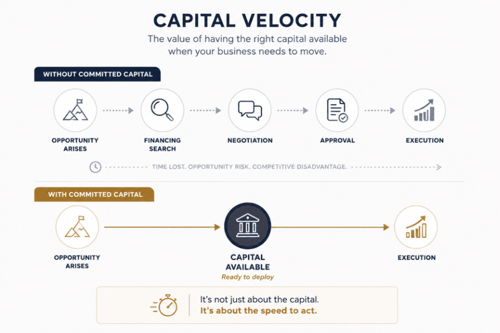
Consider two financing options. One offers a slightly lower rate but requires rigid repayment terms, limited flexibility and a new approval process whenever additional capital is needed. The other costs somewhat more but provides greater certainty of execution, more appropriate repayment terms and committed capacity for a planned acquisition programme.
The second facility may create more strategic value even if its headline cost is higher.
This is particularly relevant in M&A. A delayed draw term loan, for example, can provide committed capital that a business can access later for qualifying acquisitions, reducing the need to renegotiate financing every time an opportunity emerges. The value lies not only in the amount available, but in the speed and certainty with which it can be deployed.
That is capital velocity: the economic value of having the right capital available when a business needs to move.
For a company competing for an acquisition, funding certainty can influence whether an opportunity is actionable at all.
Matching the structure to the objective
The right financing begins with the purpose of the capital.
Growth capital, acquisition finance, refinancing and working capital may all require debt, but they place different demands on the business and the lender.
A company pursuing a buy-and-build strategy may benefit from a facility that combines committed funding with the flexibility to draw capital as acquisitions arise. A business with significant receivables or inventory may be better suited to an asset-backed structure where borrowing capacity is linked to eligible assets. A company refinancing existing debt may need a structure that provides sufficient headroom for its next phase of investment rather than simply replacing the existing facility.
The distinction is important because a financing structure that works well for one business can be poorly suited to another.
A recurring-revenue software company, for example, has different financing characteristics from an asset-intensive manufacturer. A professional services business funding an acquisition has different requirements from a company managing a seasonal working capital cycle.
Funding fit starts with the economics of the business.
The balance sheet can offer more than EBITDA
One of the most significant developments within private credit is the growing role of asset-backed finance.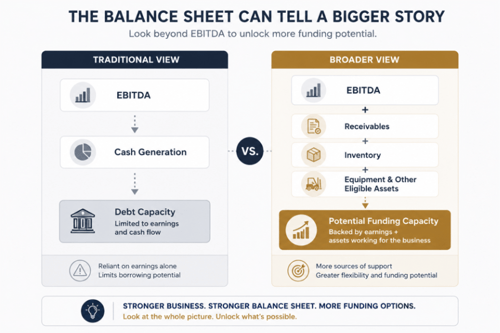
Asset-backed structures can allow businesses to access capital against eligible assets such as receivables, inventory or equipment. For companies with meaningful asset bases, this can provide another route to liquidity alongside traditional cash-flow lending.
This changes the way businesses can think about their borrowing capacity.
The question is not always simply, “How much debt can our EBITDA support?”
It can also be:
“What does the wider balance sheet enable us to finance?”
The answer will depend on the quality, liquidity and eligibility of the assets involved, as well as the structure of the facility. Asset-backed finance remains debt and can still involve covenants, security and leverage considerations. Its potential advantage is that the financing capacity can be linked more directly to the underlying asset base rather than relying exclusively on earnings.
For businesses with substantial working capital requirements, that distinction can be meaningful.
Refinancing is a chance to redesign, not just replace
Refinancing is often treated as a deadline.
An existing facility is approaching maturity, so the priority becomes finding a replacement before the clock runs out.
A more strategic approach starts earlier.
A business can change significantly during the life of a loan. Revenue may have grown, margins may have improved, new assets may have been acquired, the company may have entered new markets or its working capital requirements may have changed.
The financing that suited the business three years ago may no longer be the financing it needs today.
Private credit continues to play an important role in refinancing activity, particularly as existing facilities mature and businesses reassess their capital structures. Starting the process with sufficient time allows management to consider whether the existing structure still works, explore alternatives and negotiate from a position of choice rather than urgency.
A refinancing can therefore become an opportunity to build the capital structure around the next three to five years of the business, rather than simply the next maturity date.
Flexibility has value, but it is never free
Tailored financing can create useful flexibility, but flexibility should not be confused with a free option.
Some structures allow borrowers to defer certain cash interest payments or provide additional flexibility during periods of investment. A PIK feature, for example, can allow eligible interest to be capitalised rather than paid in cash, helping preserve short-term liquidity during a heavy investment phase.
But the trade-off matters. Capitalised interest increases the outstanding debt balance and can increase leverage and future repayment obligations.
The same principle applies to other forms of flexibility.
A covenant package that provides more headroom may come with a higher cost. A longer tenor may affect pricing. Greater availability may involve commitment fees or other structural considerations.
The objective is not to maximise flexibility at any cost.
It is to pay for the flexibility that the business genuinely needs.
A simple Funding Fit framework
Before approaching lenders, businesses can benefit from asking five questions.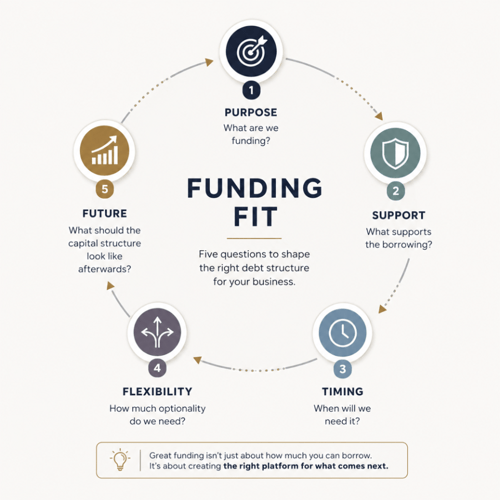
What are we funding?
Is the requirement driven by growth, an acquisition, refinancing, working capital, capital expenditure or another strategic objective?
What supports the borrowing?
Is the strongest source of repayment predictable cash generation, receivables, inventory, equipment, contracted revenues or a combination of factors?
When will we need the capital?
Does the business need the full facility immediately, or would committed capital available for future requirements create greater value?
How much flexibility will the strategy require?
Will the business need additional acquisition capacity, future drawings, repayment flexibility or headroom for unexpected changes?
What does the capital structure need to look like after the transaction?
Will the business still have sufficient liquidity and capacity to execute its plans once the financing is in place?
These questions shift the conversation from “How much can we borrow?” to “What financing structure gives us the best platform for what we want to achieve?”
That is a much more useful starting point.
Think beyond today's transaction
The smartest financing decisions consider what happens after the capital is deployed.
For an acquisition, that means thinking about integration costs, working capital and the capacity to pursue future opportunities.
For a growth investment, it means considering when the investment is expected to generate cash and whether the repayment profile reflects that trajectory.
For a refinancing, it means asking whether the new structure provides enough flexibility for the next stage of the business.
For working capital, it means considering whether the facility can evolve as the company's scale and requirements change.
Private credit can offer businesses a broader funding toolkit, but more options make the selection process more important, not less.
The right debt structure should support the business's operating model and strategic direction. It should give management sufficient room to execute without creating unnecessary constraints elsewhere in the capital structure.
Private credit is becoming more tailored
The evolution of private credit is ultimately about more than market size.
As the asset class expands into different strategies, structures and borrower types, the distinction between “private debt” and a single standardised loan becomes increasingly blurred.
Businesses can access capital designed around different combinations of cash flow, assets, transaction requirements and strategic objectives.
That is where the opportunity lies.
Debt can fund an acquisition. It can accelerate expansion. It can unlock working capital. It can support investment in assets. It can provide a route to refinancing. For privately owned businesses, it can also provide growth capital without requiring an immediate change in ownership.
But the value of debt is determined by more than the amount raised.
It is determined by how well the capital fits the business.
Making capital work harder
At Fuse Capital, we help businesses navigate the private debt market and identify funding solutions aligned with their strategic requirements.
Whether the need is growth capital, acquisition finance, refinancing, working capital, asset-backed finance or another tailored solution, we start by understanding the business, its objectives and the role the capital needs to play.
We then connect businesses with appropriate lenders from our global network, helping them evaluate structures based on more than headline pricing alone.
Because smarter debt is not necessarily about borrowing more.
It is about making the capital you raise work harder for the business you are building.